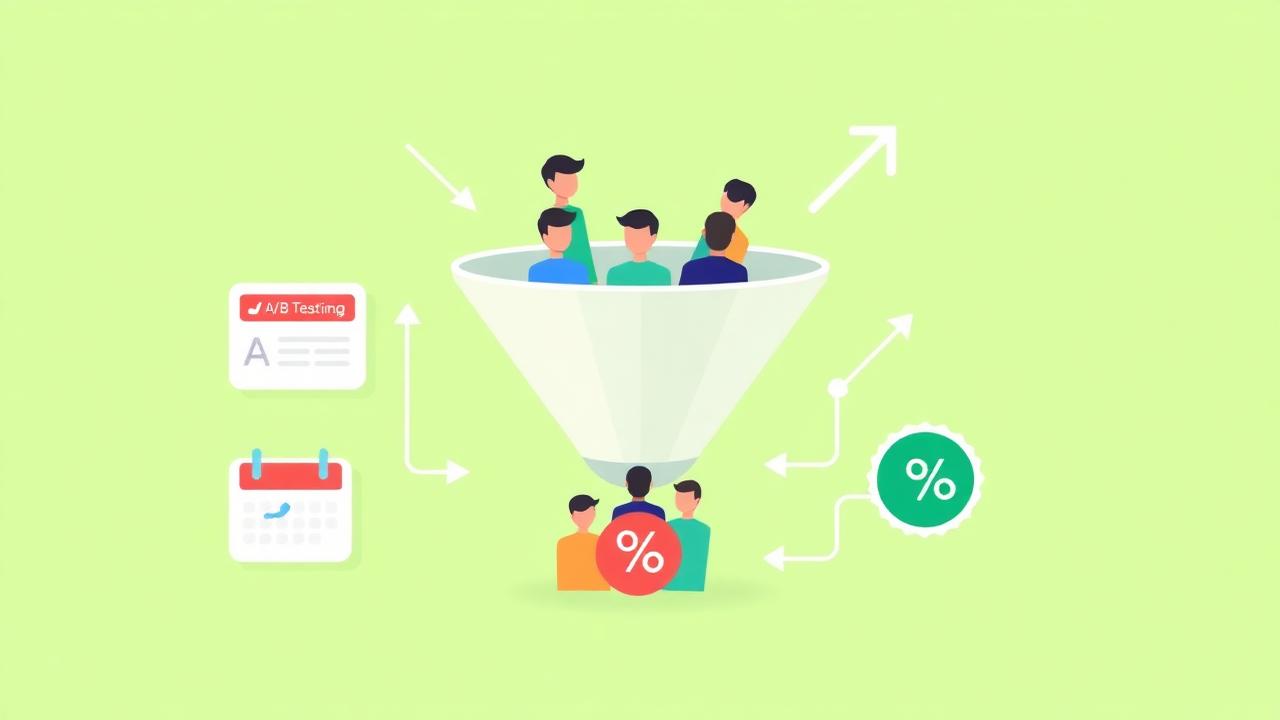

Conversion rate optimization (CRO) is the systematic process of increasing the percentage of website visitors who take a desired action — whether that's making a purchase, signing up for a trial, or submitting a lead form. Unlike traffic acquisition, CRO focuses on getting more value from visitors you already have, making it one of the highest-ROI marketing activities available.
This comprehensive guide covers the entire CRO discipline: from foundational frameworks to advanced tactics, with a focus on how social proof accelerates conversion improvements across every industry.
What Is Conversion Rate Optimization?
CRO is the data-driven practice of improving your website's ability to convert visitors into customers — using research, testing, and iterative design changes to remove friction and increase motivation at every stage of the funnel.
At its core, CRO answers one question: "Why aren't more visitors converting?" The answer is always some combination of friction (things that slow visitors down or create uncertainty) and motivation (reasons to take action). Every CRO tactic either reduces friction or increases motivation — ideally both.
The conversion rate formula is straightforward: Conversion Rate = (Number of Conversions ÷ Total Visitors) × 100. An e-commerce store with 50,000 monthly visitors and 1,500 purchases has a 3% conversion rate. If CRO efforts increase that to 4%, that's a 33% revenue increase with zero additional traffic spend. CRO is not guesswork or "best practices" — it's a structured, evidence-based process that combines qualitative research (user interviews, session recordings, surveys) with quantitative testing (A/B tests, multivariate experiments) to identify what actually moves the needle for your specific audience.
Why Does CRO Matter More Than Traffic?
Doubling your conversion rate is equivalent to doubling your traffic — but costs a fraction of the price and compounds permanently, while paid traffic stops the moment you stop paying.
Most businesses default to acquiring more traffic when they want more revenue. But traffic acquisition has diminishing returns — CPCs increase, audiences saturate, and every new visitor costs more than the last. CRO inverts this equation by making every existing visitor more valuable.
Consider the math: if you spend $10,000/month on ads driving 50,000 visitors at a 2% conversion rate, you get 1,000 customers. Improving your conversion rate to 3% gives you 1,500 customers — the equivalent of spending $15,000 on ads, but without the extra $5,000/month in ad spend. And unlike ads, CRO improvements compound: they apply to all future traffic from every source.
This is why the most successful growth teams invest in CRO alongside traffic acquisition. Social proof is one of the fastest CRO wins because it simultaneously reduces uncertainty (friction) and creates urgency (motivation) — and implementation takes minutes, not months.
What Is the CRO Process Framework?
The CRO process follows five stages: Research → Hypothesize → Prioritize → Test → Analyze — then repeat. The best teams run this cycle continuously, producing 3–5% monthly conversion improvements that compound into transformative annual growth.
1. Research: Identify where and why visitors drop off. Use heatmaps, session recordings, user surveys, and analytics data to find friction points. Common culprits: confusing navigation, weak value propositions, missing trust signals, and slow page loads.
2. Hypothesize: Form specific, testable hypotheses. Not "the page must be better" but "Adding real-time purchase notifications to the product page will increase add-to-cart rate by 15% because visitors will feel validated by seeing others buying."
3. Prioritize: Use the ICE framework — a prioritization method that scores each hypothesis on Impact (potential uplift), Confidence (evidence strength), and Ease (implementation effort) — to rank hypotheses. High-impact, high-confidence, easy-to-implement changes — like adding social proof notifications — must be tested first.
4. Test: Run statistically rigorous A/B tests with sufficient sample size and duration. Don't peek at results early — let tests reach 95% confidence before drawing conclusions.
5. Analyze and Iterate: Document winners and losers. Understand why a test won, not just that it won. Apply learnings to generate new hypotheses and start the cycle again.
Which CRO Metrics Do You Track?
Focus on conversion rate, revenue per visitor, average order value, bounce rate, time to conversion, and micro-conversion rates — segmented by device, traffic source, and user type for actionable insights.
- Conversion rate (CR): Your primary KPI. Segment by page, device, traffic source, and new vs. returning visitors. Industry benchmarks: e-commerce 2–4%, SaaS free trial 5–15%, lead gen 10–20%.
- Revenue per visitor (RPV): Total revenue ÷ total visitors. More useful than CR alone because it accounts for order value. A page with 2% CR and $200 AOV generates more than 4% CR at $50 AOV.
- Average order value (AOV): CRO isn't just about more conversions — it's about more valuable conversions. Cross-sells, upsells, and bundle offers increase AOV.
- Bounce rate by page: High bounce rates on key conversion pages signal messaging mismatch or poor user experience.
- Micro-conversion rates: Track intermediate steps: email captures, add-to-cart, account creation, free tool usage. These leading indicators predict macro-conversions.
How Does Social Proof Drive CRO?
Social proof is the single fastest CRO lever — it addresses both trust (reducing friction) and urgency (increasing motivation) simultaneously, delivering 10–35% conversion lifts with implementation times measured in minutes rather than months.
Social proof works because it directly addresses the two biggest conversion killers: uncertainty and inertia. When a visitor sees that hundreds of others have bought, signed up, or left positive reviews, two things happen simultaneously:
- Friction decreases: "If 2,000 other businesses use this, it must work" — informational social influence reduces perceived risk
- Motivation increases: "Sarah from Austin just purchased 3 minutes ago" — urgency and FOMO accelerate the decision
NotiProof's social proof notifications, visitor counters, review aggregation, and testimonial widgets give you every social proof type in one platform — with built-in analytics to measure the impact on your conversion rate.
How Do You Optimize Landing Pages?
Landing page optimization focuses on five elements: headline clarity, value proposition strength, social proof placement, CTA design, and friction reduction — each of which can be independently tested for maximum impact.
Landing pages are where CRO produces the biggest, fastest wins. Every element on the page either helps or hurts conversion — and most pages have significant optimization potential. The key areas to focus on:
Headline and value proposition: Your headline must immediately answer "What's in it for me?" Test benefit-driven headlines vs. feature-driven ones. The best headlines combine a clear benefit with a trust signal: "Join 10,000+ businesses that increased conversions by 25%."
Social proof placement: Place social proof elements near CTAs, above the fold, and at key decision points. A testimonial next to a pricing table reduces price objections. A live visitor counter creates urgency. Recent activity notifications validate the action visitors are about to take.
For the complete landing page playbook: Landing Page Optimization Guide →
What Are the Best E-commerce CRO Tactics?
The highest-ROI e-commerce CRO tactics are reducing cart abandonment with recovery notifications, adding social proof to product pages, optimizing the checkout flow, and implementing cross-sell/upsell displays.
E-commerce stores lose an average of 70% of shopping carts to abandonment. The biggest drivers: unexpected costs, required account creation, complex checkout, and lack of trust. Cart abandonment strategies can recover 5–15% of lost revenue.
Product pages benefit enormously from layered social proof: star ratings, review counts, recent purchase notifications, and "X people viewing this" counters. NotiProof customers in e-commerce see an average 18% lift in add-to-cart rates after implementing social proof notifications.
Full guide: E-commerce Conversion Optimization →
How Do SaaS Companies Optimize Conversions?
SaaS CRO focuses on three conversion points: visitor-to-trial (landing page optimization), trial-to-activation (onboarding optimization), and activation-to-paid (value demonstration and social proof during the trial period).
SaaS conversion funnels are longer and more complex than e-commerce. The key is optimizing each transition: landing page → free trial → onboarding → activation → payment. Social proof plays a different role at each stage — from "Join 5,000+ companies" on the landing page to "Your team just completed setup!" during onboarding.
Full guide: SaaS Conversion Optimization →
How Do You Test and Iterate?
Effective CRO testing requires statistical discipline: calculate sample size before launching, run tests for at least 2 full business cycles, test one variable at a time, and document every result — winners and losers alike.
Testing is the heart of CRO. Without testing, you're just guessing — and most guesses are wrong. Research shows that only 1 in 7 A/B tests produces a statistically significant positive result, which means intuition alone will lead you astray. The key principles:
- Statistical significance: Use a sample size calculator before launching any test. At 95% confidence with 80% power, you need ~30,000 visitors per variation to detect a 10% relative improvement on a 3% baseline CR.
- One variable at a time: If you change both the headline and the CTA simultaneously, you won't know which change caused the result. Sequential A/B tests isolating single variables produce actionable insights.
- Full business cycles: Run tests for at least 2 weeks to capture day-of-week and time-of-day effects. A test that only runs Tuesday through Thursday will produce skewed results.
What CRO Tools Do You Need?
A complete CRO stack includes analytics (GA4 + NotiProof Analytics), qualitative research (heatmaps + session recordings), A/B testing, social proof (NotiProof), and form optimization tools.
- Analytics: Google Analytics 4 for traffic and behavior data, plus NotiProof Analytics for social proof impact measurement
- Qualitative research: Hotjar (a behavior analytics tool for heatmaps and session recordings) or FullStory for heatmaps and session recordings
- Social proof: NotiProof for notifications, testimonials, review widgets, and visitor counters
- A/B testing: NotiProof's built-in A/B testing for social proof elements; Optimizely or VWO for page-level tests
- ROI measurement: Social Proof ROI Calculator for quick impact estimates
Explore the Full CRO Guide
Dive deeper into specific CRO topics:
Related: Conversion Analytics Guide · Social Proof Guide