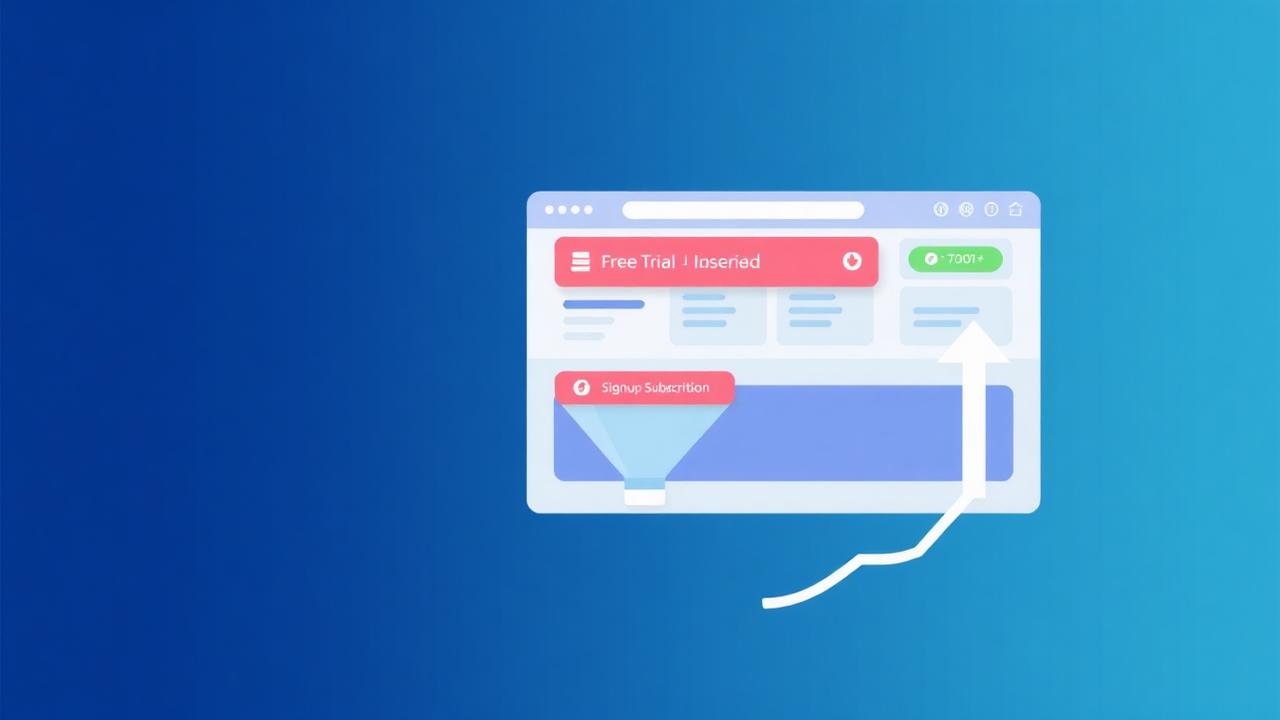

SaaS conversion optimization is fundamentally different from e-commerce CRO. Instead of a single purchase decision, you're optimizing a multi-stage funnel: visitor → trial → activation → paid. Each transition requires different tactics, different social proof strategies, and different metrics.
What Does the SaaS Conversion Funnel Look Like?
The SaaS funnel has three critical conversion points — visitor-to-trial (5–15%), trial-to-activation (20–40%), and activation-to-paid (25–60%) — and each requires different optimization strategies and social proof types.
Unlike e-commerce where the goal is a single transaction, SaaS companies need visitors to commit to a multi-step relationship. The typical SaaS funnel benchmarks:
- Visitor → Free Trial: 5–15% (landing page optimization)
- Trial → Activated: 20–40% (onboarding optimization)
- Activated → Paid: 25–60% (value demonstration and conversion triggers)
The compounding math is critical: if you optimize each stage by just 20%, your overall conversion rate increases by 73% (1.2 × 1.2 × 1.2 = 1.73). This is why SaaS CRO focuses on the full funnel, not just the landing page.
How Do You Convert Visitors to Trial Users?
Visitor-to-trial conversion requires a clear value proposition, minimal signup friction (name + email only), prominent social proof ("Join 5,000+ companies"), and a CTA that emphasizes low commitment ("Start Free — No Credit Card").
The landing page is where most SaaS companies lose the majority of potential users. Key optimization areas:
Reduce signup friction to near zero: Every field you add reduces signups by 5–10%. Start with email-only or name + email. You can collect company details during onboarding. Offering social login (Google, GitHub) can increase signups by 15–25%.
Lead with social proof: "Join 5,000+ companies" or "Trusted by teams at Shopify, Stripe, and HubSpot" immediately establishes credibility. Real-time signup notifications — "Another team just signed up 2 minutes ago" — create momentum that makes the signup feel like joining a movement, not taking a risk.
Free trial vs. freemium: Test both models. Free trials with no credit card typically convert 25–60% more visitors into trial users, though freemium can generate higher volume. The right choice depends on your product complexity and sales model.
How Do You Drive Trial Activation?
Activation optimization focuses on getting users to their "aha moment" as fast as possible — through guided setup flows, progress indicators, contextual help, and social proof that shows other users successfully completing the same steps.
Activation is the most underoptimized stage in most SaaS funnels. If a trial user never experiences your core value, they will never convert to paid. The key is identifying your "aha moment" — the specific action that correlates most strongly with long-term retention — and engineering the onboarding flow to reach it fast.
Social proof during onboarding is powerful but underused: showing "85% of teams complete setup in under 5 minutes" normalizes fast action. NotiProof uses this principle — after a user installs the script tag, seeing "Your first notification will appear in under 60 seconds" combines expectation-setting with the aha moment.
How Do You Convert Activated Users to Paid?
Activation-to-paid conversion requires demonstrating measurable value — show ROI dashboards, usage reports, and case studies from similar companies to make the upgrade decision feel like protecting an investment, not making a new one.
Once users experience value, the conversion to paid feels like protecting something they already have, not buying something new. Key tactics:
- Value dashboards: Show measurable impact: "Your social proof notifications were seen 5,240 times and influenced 47 conversions this month." NotiProof's analytics dashboard makes this impact visible.
- Peer comparison: "Companies like yours typically see 25% higher conversion rates on our paid plan" uses social proof to frame the upgrade as joining a successful peer group.
- Gentle urgency: "Your trial ends in 3 days — lock in your current analytics and campaign data" frames the upgrade as loss prevention, not a purchase.
How Do You Optimize Your Pricing Page?
SaaS pricing pages convert best with 3–4 tiers, a visually highlighted "recommended" plan, social proof under each tier, annual billing incentives, and an FAQ section addressing objections directly.
The pricing page is the final conversion gatekeeper. Optimization priorities:
- 3–4 tiers maximum: More choice creates decision paralysis. Highlight the recommended tier visually.
- Social proof per tier: "Most popular" badges, customer counts per plan, or testimonials from users on that specific tier.
- Objection handling: An FAQ below pricing that addresses "What if I outgrow this plan?", "Can I cancel anytime?", and "Is my data secure?"
- Real-time validation: Recent activity notifications showing other teams signing up validates the decision at the critical moment.
What Social Proof Works Best for SaaS?
SaaS benefits most from logo bars (brand credibility), metric-based proof ("10,000+ teams"), case studies with ROI data, G2/Capterra ratings, and real-time signup notifications — all targeting different objections at different funnel stages.
SaaS social proof differs from e-commerce because the buyer journey is longer and the decision involves more stakeholders. The most effective types:
- Client logos: Recognizable brand logos build instant credibility with enterprise buyers
- Metric-based proof: "Trusted by 10,000+ teams" or "Processing 5M notifications/month" demonstrates scale
- Case studies with ROI: "How CloudMetrics increased trial-to-paid by 42%" provides concrete evidence for budget holders
- Third-party validation: G2 ratings, Capterra scores, and industry awards add impartial credibility
- Real-time signups: "Another SaaS team just started their free trial" on the pricing page creates momentum
How Does Onboarding Impact Conversion?
Onboarding is the most under-optimized conversion lever in SaaS — companies that reduce time-to-value from 10 minutes to 2 minutes typically see 30–50% higher trial-to-paid conversion rates.
The single biggest predictor of trial-to-paid conversion is how quickly users reach their first moment of value. Every unnecessary step, confusing UI element, or knowledge gap between signup and value is a conversion leak.
Best practices: guided setup wizards with pre-populated defaults, progress indicators, contextual tooltips, and a clear "you're ready!" confirmation when setup is complete. Show the user their first result (first notification displayed, first review collected) as fast as possible.
Key Takeaways
- SaaS has three conversion stages — optimizing each by 20% gives a 73% overall improvement
- Reduce signup friction to email-only; collect details during onboarding
- The "aha moment" is the most important metric for trial-to-paid conversion
- Value dashboards showing measurable ROI make the paid upgrade feel like protecting an investment
- Pricing pages convert best with 3–4 tiers and social proof under each option
- Real-time signup notifications create momentum at every stage of the SaaS funnel